One Veto Can Block the World: How Regional Unions Can Reduce UN Paralysis
Copyright © 2026 Noble World Foundation. All rights reserved.
By Shiv R. Jhawar, MAS, EA, CA
“Aggressive war is the supreme international crime because it contains within itself the accumulated evil of the whole.”
— Judgment of the International Military Tribunal at Nuremberg, 1946.[1]
War is fought not only on battlefields. It is also fought in public opinion, diplomacy, and law. Legitimacy matters. It can shape alliances, build pressure, and slow escalation.
International law does not stop every war at the first blow. But it can raise the cost of aggression. It can help governments hold the line. In that sense, law can serve as a brake on war.
The United Nations (UN) was created to place legal and moral limits on the use of force. Yet the very institution meant to preserve peace can fall short when action is most needed.
The UN’s Built-In Contradiction
The UN can confer global legitimacy on collective action. But it cannot easily override the great powers whose participation was considered essential to its survival.
When the UN Charter was drafted in 1945, its authors faced a hard reality. A collective-security system would not work unless the strongest states agreed to remain inside it. Their answer was the veto.
Five states—the United States, China, France, Russia, and the United Kingdom—hold permanent seats on the UN Security Council (UNSC). Each can block a substantive Council decision.[2]
The arrangement helped bring the major powers into the postwar order. But it also created a grave weakness. One government can stop the UNSC from acting even when most UN Member States seek action.
One Veto Can Block the World
A single negative vote by a permanent member can defeat a substantive UNSC resolution.[2]
That problem has surfaced repeatedly. Russia vetoed a UNSC draft resolution addressing its full-scale invasion of Ukraine in February 2022.[3] The United States has also vetoed several Gaza ceasefire resolutions, including one in June 2025 that had the support of the other fourteen Council members.[4]
In such moments, broad concern may be visible in the UN General Assembly (UNGA) and around the world. Yet the UNSC cannot adopt binding action.
That is not collective security at its best.
It is a structure in which paralysis can be built into the process.
A system once designed to prevent confrontation among great powers can now prevent the international community from responding effectively to crises that threaten global peace.
A Growing Crisis of Trust
States in Africa, Asia, Latin America, and other underrepresented regions increasingly ask whether a structure designed in 1945 can fairly represent the world of today.
Africa has no permanent UNSC seat. Latin America and the Caribbean have none. Much of Asia remains without permanent representation proportionate to its population, political importance, or stake in global stability.
Repeated veto deadlock weakens trust in the UN when international cooperation is most needed.
The writing is on the wall. A system that cannot respond to its greatest tests will steadily lose authority.
A Legal Opening Worth Examining
Many observers believe meaningful UNSC reform is impossible because it requires a formal amendment to the UN Charter. Charter amendment remains the clearest legal route, and Article 108 sets a demanding process.[2]
History, however, shows that the UN has adapted to major geopolitical changes through political acceptance and institutional practice.
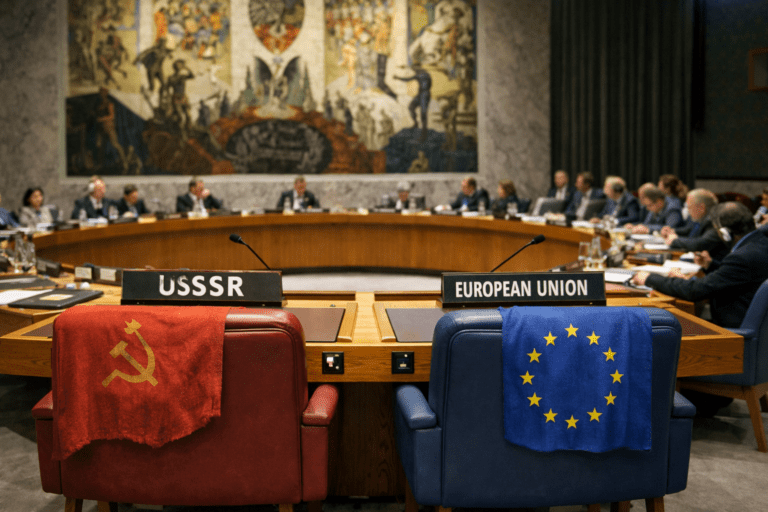
In December 1991, the Union of Soviet Socialist Republics (USSR) dissolved into fifteen independent states. The Russian Federation informed the UN Secretary-General that it would continue the USSR’s membership, including its UNSC seat. The transition was accepted in practice without a Charter amendment or a separate UNGA or UNSC vote.[5]
That episode should not be treated as a ready-made legal formula. It does not mean that every new political arrangement can bypass the Charter.
But it does show that the UN system has responded flexibly when political reality, institutional continuity, and broad acceptance came together.
The lesson is not that law can be ignored.
The lesson is that law and political reality must eventually meet.
From National Seats to Regional Representation
The world is increasingly organized through regional cooperation.
Regional organizations coordinate trade, diplomacy, security, development, and economic policy. The European Union (EU) is the most developed example. It has legal personality, concludes international agreements, and acts for its Member States in fields within its competence.[6]
Other regional bodies are also building up their roles. These include the African Union (AU), the Association of Southeast Asian Nations (ASEAN), the Community of Latin American and Caribbean States (CELAC), and regional groupings in Eurasia.
The world’s greatest challenges—climate change, pandemics, terrorism, displacement, food insecurity, and war—do not stop at national borders. They spill over.
No state, however powerful, can sort out these problems alone.
Regional representation would reflect the way many countries already manage cross-border challenges: by working through common institutions, shared interests, and negotiated positions.
Why Regional Representation Matters
Replacing, or gradually transforming, permanent national seats into forms of regional representation could serve two long-overdue purposes.
First, it could improve geographic balance. Africa, Latin America, and other underrepresented regions could gain a more meaningful and continuing voice in decisions affecting international peace and security.
Second, it could reduce the ability of a single national government to block action alone. A regional position would usually require internal consultation, negotiation, and a broader base of consent.
When responsibility is shared, legitimacy grows.
The UNSC already gives weight to equitable geographic distribution when electing non-permanent members.[2] Extending that principle to more enduring forms of representation would not be radical. It would bring the Council closer to present-day political realities.
Reform Through Evolution, Not Disruption
Reform need not happen overnight.
Regional organizations could first receive more structured participation in UNSC deliberations. The EU, with its developed institutions and legal capacity, could offer a useful pilot case for examining how regional representation might work in practice.
Over time, the UN could work out clear procedures for regional participation, consultation, accountability, and voting. Such reforms would require careful legal design and broad political support. They should not be imposed by unilateral action.
Procedural changes could also reduce paralysis. On matters of international peace and security, blocking action might require concurrence among more than one permanent or regional representative rather than a single negative vote.
The purpose is not to weaken the UN.
It is to make the UN more capable of carrying out the mission for which it was created.
Law as a Brake on War
International law cannot eliminate every war. But it can shape diplomacy, influence public judgment, isolate unlawful conduct, and strengthen the demand for restraint.
The UN remains the central forum in which the rules governing peace, war, and international responsibility are debated and defended.
Strengthening its capacity to act is therefore essential to the cause of peace.
The Choice Before Humanity
The UN Charter opens with the words, “We the Peoples.” Those words were meant to express a shared human purpose.[2]
Today, they stand in tension with a system in which five permanent members can block action through a single veto.
The world has changed. The UNSC has not changed enough.
Global governance will not retain credibility simply by standing still. Institutions designed in 1945 must evolve with the realities of the twenty-first century.
Regional representation offers one practical path toward a more balanced and cooperative system. It would preserve the UN while making its structure better reflect the world it serves.
Without reform, continuing UNSC paralysis will erode confidence in the international order.
The UN was created to prevent the devastation of war and safeguard future generations. Keeping it capable of carrying out that mission is one of the defining responsibilities of our time.
History teaches a simple lesson: institutions that fail to evolve eventually lose the authority they were created to protect.
Peace will remain distant so long as humanity builds institutions around power and privilege rather than shared responsibility. Lasting peace requires wise institutions, moral restraint, and a civilization that treats all life with dignity and respect.
If the UN cannot reform the veto, the veto may ultimately deform the UN into irrelevance.
References
[1] International Military Tribunal, Judgment of the International Military Tribunal for the Trial of German Major War Criminals, 1946.
[2] Charter of the United Nations, arts. 1, 23, 27, 108; see also provisions concerning equitable geographic distribution in the election of non-permanent UNSC members.
[3] UN Security Council, draft resolution on Ukraine, vetoed by the Russian Federation, 25 February 2022; UN General Assembly Resolution ES-11/1, Aggression against Ukraine, 2 March 2022.
[4] UN Security Council, draft resolution calling for an immediate, permanent ceasefire in Gaza, vetoed by the United States, 4 June 2025.
[5] Letter dated 24 December 1991 from Boris Yeltsin, President of the Russian Federation, to the UN Secretary-General, concerning continuation of USSR membership by the Russian Federation; UN membership records.
[6] Treaty on European Union, art. 47; United Nations General Assembly Resolution 65/276, Participation of the European Union in the Work of the United Nations.
About the Author
Shiv R. Jhawar, MAS, EA, CA, is the founder and president of Noble World Foundation and author of Building a Noble World, a book exploring global unity through spiritual awakening.
About Noble World Foundation
Founded in 2004, Noble World Foundation in Chicago is a 501(c)(3) nonprofit organization. Its mission is to inspire change within individuals through meditation. Individuals are the world. When individuals change, the world changes.
Timeline: Ukraine War and UN Actions
24 February 2022 — Russia begins its full-scale military invasion of Ukraine. The action is widely condemned as inconsistent with the UN Charter’s prohibition on the threat or use of force against another state’s territorial integrity or political independence.
25 February 2022 — Russia vetoes a UN Security Council draft resolution, submitted by Albania and the United States, that would have deplored Russia’s aggression against Ukraine and demanded an immediate end to the offensive. Eleven Council members voted in favor; China, India, and the United Arab Emirates abstained.
2 March 2022 — The UN General Assembly adopts Resolution ES-11/1, Aggression against Ukraine, by 141 votes to 5, with 35 abstentions. The resolution deplores Russia’s aggression and demands that Russia immediately cease its use of force and withdraw its military forces from Ukraine.
16 March 2022 — The International Court of Justice orders Russia to suspend immediately the military operations it began on 24 February 2022 in Ukraine. The order was issued as a provisional measure in Ukraine’s case under the Genocide Convention.
7 April 2022 — The UN General Assembly suspends Russia from the Human Rights Council by 93 votes to 24, with 58 abstentions.
26 April 2022 — The UN General Assembly adopts Resolution 76/262, requiring the General Assembly to meet automatically within ten working days whenever a permanent member casts a veto in the Security Council.
30 September 2022 — Russia vetoes a Security Council draft resolution condemning its attempted annexation of four Ukrainian regions and declaring the referendums invalid.
12 October 2022 — The General Assembly adopts Resolution ES-11/4 by 143 votes to 5, with 35 abstentions. It condemns Russia’s attempted illegal annexation of four Ukrainian regions and demands that Russia reverse its decisions.
23 February 2023 — The General Assembly adopts Resolution ES-11/6, calling for a comprehensive, just, and lasting peace in Ukraine consistent with the UN Charter and demanding Russia’s immediate, complete, and unconditional withdrawal from Ukraine.
17 March 2023 — The International Criminal Court issues arrest warrants for Vladimir Putin and Maria Lvova-Belova. The warrants concern alleged war crimes relating to the unlawful deportation and transfer of Ukrainian children from occupied areas of Ukraine. They do not allege genocide or crimes against humanity in the warrants issued that day.
31 January 2024 — The International Court of Justice delivers its judgment in Ukraine v. Russian Federation under the Terrorism Financing Convention and the Convention on the Elimination of Racial Discrimination. The Court finds certain violations by Russia, including failures concerning education in Crimea, while rejecting or declining to uphold many of Ukraine’s other claims. This case concerns events beginning in 2014 and is distinct from the ICJ’s 2022 provisional-measures order concerning the full-scale invasion.