
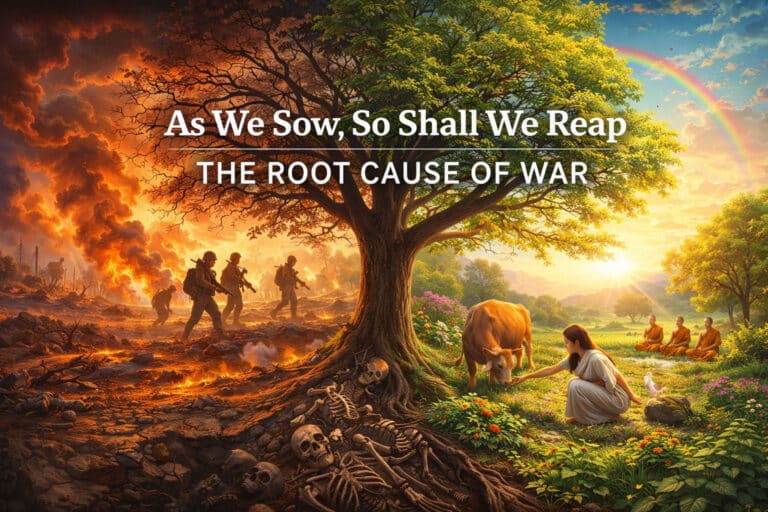
War’s Root Cause: Violence Begins Where Compassion Ends
By Shiv R. Jhawar, MAS, EA, CA
War does not begin only when armies cross borders. It begins earlier—in the habits of mind that allow suffering to become ordinary, distant, or morally invisible.
This article does not claim that animal slaughter alone causes war. Human conflict has many causes: fear, power, ideology, grievance, poverty, and political ambition. Yet a civilization that becomes indifferent to the suffering of vulnerable beings may weaken the moral restraints that make compassion possible.
When violence is normalized in one sphere of life, it can become easier to accept violence elsewhere. The question is not whether every person who eats meat becomes violent. The question is whether repeated social acceptance of avoidable suffering narrows our capacity for empathy.
The Moral Continuity of Nonviolence
Across spiritual traditions, nonviolence has been treated not merely as a rule of conduct but as a discipline of consciousness.
The Yoga Sutras place ahimsa, or nonviolence, first among the yamas—the foundational ethical restraints. The teaching is simple: before the mind can become clear, conduct must become less harmful.
Buddhist and Jain traditions likewise place compassion toward living beings at the center of ethical life. Their shared insight is that cruelty does not remain neatly confined to its chosen target. It shapes the person who permits it, performs it, or learns to ignore it.
Leo Tolstoy expressed a similar moral concern in his writings on nonviolence and the treatment of animals. Rather than relying on a disputed quotation, the point may be stated plainly: a culture that trains itself to overlook suffering risks dulling the conscience on which peace depends.
What Research Suggests About Desensitization
Modern psychology does not establish a simple line from animal slaughter to war. It does, however, document serious concerns associated with repeated occupational exposure to killing and injury in slaughterhouse settings.
A systematic review of the literature found that slaughterhouse workers may experience higher rates of depression, anxiety, trauma-related symptoms, and violence-supportive attitudes. Researchers have also examined emotional numbing, stress, nightmares, relationship difficulties, and what has been described as perpetration-induced traumatic stress. These findings should be interpreted carefully: they identify associations and occupational risks, not proof that any one worker or community will become violent.
The moral lesson remains important. A society should not treat routine exposure to killing as psychologically or ethically insignificant.
Compassion Is a Social Safeguard
A humane society protects those who cannot protect themselves. That principle applies to children, the elderly, people with disabilities, marginalized communities, and nonhuman animals.
Animals can experience fear, pain, stress, attachment, and the desire to avoid harm. Recognition of their sentience does not require us to deny human needs or ignore difficult questions of food, culture, livelihood, and survival. It asks something more basic: that human power be guided by conscience.
Compassion is not weakness. It is a form of moral strength.
When people cultivate sensitivity toward suffering, they also cultivate restraint. They become less willing to justify cruelty merely because it is customary, profitable, or hidden from view.
A Path Toward Real Reform
Legal reform matters. Humane standards, improved enforcement, transparency, and reduced cruelty can lessen suffering. Yet legal rules alone cannot fully address the moral problem.
The deeper task is inward. We must ask what kind of consciousness is formed when killing is made ordinary and suffering is removed from sight.
Real reform begins when compassion is no longer treated as sentimentality. It becomes a principle of personal conduct, public policy, and social responsibility.
A Choice for Humanity’s Future
Humanity stands at a crossroads.
We can continue to accept immense suffering as the cost of convenience, while hoping that peace will somehow arise from a culture accustomed to indifference. Or we can enlarge our circle of compassion and recognize that peace cannot be separated from the way we treat the vulnerable.
War has political causes, economic causes, and historical causes. But beneath them lies a moral question: do we see life as something to dominate, or something to respect?
A more peaceful world will require wise institutions, just laws, and courageous diplomacy. It will also require hearts trained in compassion.
Peace grows where cruelty loses its place in human consciousness.